Hiển thị các bài đăng có nhãn pork. Hiển thị tất cả bài đăng

Thứ Tư, 15 tháng 10, 2014

The "Trouble with Antibiotics" in U.S. animal agriculture production

Frontline last night had an excellent report, the Trouble with Antibiotics, on the plausible link between dangerous antibiotic resistant diseases and the overuse of antibiotics in U.S. meat production.

Poultry and hog producers use large amounts of antibiotics even in healthy animals, as a growth promoter and to prevent disease. As bacteria evolve to become resistant to these antibiotics, we lose important tools for treating deadly diseases in humans, including Methicillin-resistant Staphylococcus aureus (MRSA).

For readers who want to inspect the scientific evidence for themselves, here are some links to research mentioned in the Frontline report.

Jessica Rinsky, Lance Price (interviewed in the report), and colleagues found livestock-associated MRSA in workers from industrial livestock operations but not workers from antibiotic-free livestock operations.

Andrew Waters, Lance Price, and colleagues found that MRSA bacteria reaches meat on supermarket shelves.

Joan Casey, Brian Schwartz, and colleagues found in the Journal of the American Medical Association (JAMA) that antibiotic-resistant bacteria cases in humans were geographically associated with the proximity of nearby meat producers in Pennsylvania. The Frontline interviewer did a great job questioning the scientists and explaining both the strengths and limits of this type of geographic association.

Concerned about the Frontline story, the federal government's National Pork Board has been scrambling to persuade people not to worry about this issue. Reuters reports today that the NPB is funding an online public information campaign to defend antibiotic use. The most damning part of the Reuters report alleges that the NPB is using search engine optimization (SEO) tools so that web users seeking information about antibiotics are directed to industry-friendly web sources.

Both Reuters and the Frontline report describe the pork board as an "industry" association, but the National Pork Board is a semi-public checkoff program. The U.S. Congress created this board, the Secretary of Agriculture appoints its members from a slate of candidates suggested by the industry, and the federal government uses its powers of taxation to collect the "mandatory assessment" -- a tax -- that funds this public information campaign. This is not a voluntary industry association. All pork board messages must be approved by the federal government as its own "government speech," so our government is complicit in this public information campaign to rebut the Frontline report.

The industry representatives interviewed in the Frontline report didn't really dispute any of the facts, but they engaged in a rhetorical game of shifting the burden of proof. They argued that no further regulation is needed, because there is not yet certain proof that some of the research associations represent true cause and effect. Since nothing is ever certain in this type of research, the industry representatives can feel safe that no level of evidence would ever clear their hurdle.

One of the best passages in the Frontline report was an interview with FDA Commissioner Margaret Hamburg. The interviewer asked why FDA does not collect information about the quantity of antibiotics administered by meat producers. Though Hamburg squirmed under the question, she essentially confirmed that FDA wanted this information but could not get it because of industry opposition. In other words, the industry representatives say no action should be taken until we have certain proof, while simultaneously hindering access to the data needed to investigate the question.

The industry is pursuing some voluntary steps to reduce antibiotic use for the purpose of "growth promotion," but it has defined this term narrowly so that most antibiotic use even in healthy animals will still continue.

The Frontline report is strongly recommended. Now is the time for stronger measures to restrain the overuse of antibiotics in U.S. meat production.

Frontline, October 14, 2014.

Thứ Hai, 10 tháng 2, 2014

The Lucky Pig Recipe

The Lucky Pig

I am somewhat obsessed with a dish called the Lucky Pig, it’s served at Solbar in Calistoga and I order it almost every time I dine there. It’s basically tender roast pork served with a lot of other goodies—sesame pancakes, peanuts, jalapeños, herbs and lettuce, sauces, and even a little noodle salad. 

SolBar is a Michelin star restaurant at the Solage resort, but it’s got an approachable menu that has both healthy light options as well as more indulgent food and the staff couldn’t be nicer or more accommodating. Speaking of accommodating, to order the Lucky Pig I have to cajole other diners at my table to share it with me. The size of the roast pork shoulder varies, but it’s quite a lot of food. I also have to convince someone to go to Calistoga with me and since it’s about an hour and half drive, !’ve been working on my own version of it to enjoy at home. 

I’ve simplified the recipe quite a bit. In my opinion there are only a few elements that are really crucial, specifically the roast pork, sesame pancakes, pineapple pickles and lime wedges. You can see the original recipe from Chef Brandon Sharp as well as a scaled back version from The Mad Priest, I referred to both in creating my own recipe. It would be great for a dinner party, just be sure to start the day before. And by all means do try the original version next time you're in Calistoga. Note: The dish is on the lounge menu, but the restaurant happily serves it in the main dining room to anyone who requests it. 

The Lucky Pig
Serves about 4- 6 

Roast pork
Sesame pancakes
Pineapple pickles 
Roasted salted (or unsalted) peanuts
Sliced scallions

Butter lettuce leaves
Lime wedges
Jalapeño slices
Fresh basil, cilantro, and mint leaves
Peanut sauce
Sriracha sauce, optional 

Serve the roast pork hot, and the rest of the ingredients cool or at room temperature. Allow each guest to "roll their own" little pork stuffed pancakes with as many of the garnishes as they like. 

Roast pork
4 lbs (more or less) boneless pork shoulder
Kosher salt
10 cloves unpeeled garlic

Cut the pork into 2 pieces, pat dry, score the fat and and salt liberally on all sides. Place on a plate and let refrigerate uncovered, for 8 hours or overnight.

Preheat oven to 300 degrees. Heat a Dutch oven and sear the pork on all sides until brown. This will take about 15 minutes. Place the garlic cloves in the Dutch oven with the pork, cover and roast for about 3 hours or until very tender. I start checking it after 2 hours. 

Sesame pancakes 
1/2 cup all-purpose flour
1/2 cup bread flour
1 teaspoon Kosher salt
5 Tablespoons butter, melted and cooled
1 Tablespoon sesame oil
5 eggs
1 1/4 cups milk
2 teaspoons black sesame seeds

Blend all the ingredients except the sesame seeds, until smooth. Add the sesame seeds and transfer the mixture to the refrigerator to rest for up to 8 hours. Heat an 8 inch non-stick pan and make the crepes using about 2 Tablespoons of batter, be sure to stir the batter so each crepe has plenty of sesame seeds.

Pineapple pickles 
3 tablespoons apple cider vinegar
1 tablespoon sugar
1/2 teaspoon Kosher salt
1/2 teaspoon sriracha sauce
20 ounce can pineapple, drained

Whisk together the apple cider vinegar, sugar, salt and sriracha sauce in a bowl. Add the pineapple and let marinate in a covered container in the refrigerator for 8 hours.

Enjoy! 

Thứ Sáu, 8 tháng 11, 2013

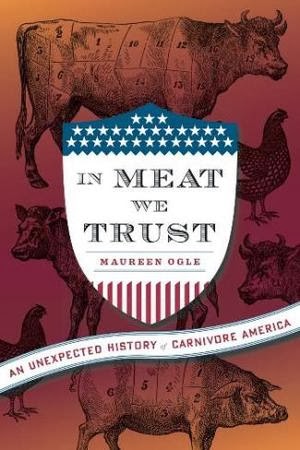
Maureen Ogle's history: In Meat We Trust

Maureen Ogle's new history of the meat industry is In Meat We Trust: An Unexpected History of Carnivore America (Houghton Mifflin Harcourt).  I enjoyed the many biographical summaries of leading industrial innovators (from Gustavus Swift to Coleman Natural Meats) and their critics (from Upton Sinclair to Michael Pollan and Michael Jacobson).

The book's most sound overall theme is that American consumers appear to demand contradictory things (perfect safety and environmental sustainability and yet low prices and massive quantities).  Ogle appeals to consumers to become more informed rather than throwing stones from afar.  In part, I think these contradictory demands arise because different consumers have always had different opinions, including sometimes well-motivated support for and concern about meat in general and industrial meat in particular.  Ogle instead treats these contradictory opinions as the ignorant and schizophrenic demand of a single personified American "we."  For example,
"If meat's American history tells us anything, it is that we Americans generally get what we want.  Meat three times a day? No problem.  Meat precut, deboned, and ready to cook?  There it is....  Organic, grass-fed, local pork and beef?  All yours, as long as you don't mind paying the price or taking the time to find it....  We're a complicated group, we Americans, and we struggle to reconcile our conflicting desires and passions."
In the end, Ogle ends up deeply skeptical of food system reformers and admiring of meat industry innovators: "So, thanks, Big Ag -- and the USDA and family and corporate farmers -- for giving us the cheap food that has nourished an extraordinary abundance of creative energy."  Here is a favorable review and interview by Chuck Jolley at Drovers Cattle Network.

Thứ Hai, 25 tháng 2, 2013

Long-hidden details revealed about the pork checkoff program's $60 million purchase of the "Other White Meat" brand

Six years after I requested these documents under Freedom of Information Act (FOIA) rules, USDA recently released unredacted copies of documents about a $60 million financial transaction between USDA's National Pork Board (a semi-public "checkoff" program) and the National Pork Producers Council (a pork industry association).

The documents reveal the shaky basis for the Pork Board's 2006 purchase of the "Other White Meat" brand from the National Pork Producers Council for $60 million.  It looks to me like the sale price was drastically inflated as a way of funneling money from the semi-public checkoff program to the private-sector trade association.

Here is how it works.  The checkoff program collects more than $40 million each year in mandatory assessments from pork producers -- whether they want to contribute or not -- using the federal government's powers of taxation.  Some dissident pork producers object to this tax, but the Department of Justice forces them to pay up.  The federal government says that the advertisements serve the public interest and officially are recognized as "government speech."  There are rules about how pork checkoff money must be spent.  For example, it is not supposed to be used for lobbying.

Some pork industry executives wished this restricted money could be transferred to the National Pork Producers Council, which faces fewer rules and is allowed to lobby as much as it likes.  In 2006, with USDA approval, the NPPC sold the property rights to the "Other White Meat" brand to the pork checkoff program for $60 million, payable at $3 million per year for 20 years.

That year, I asked USDA's Agricultural Marketing Service (AMS) to share the appraisal on which this sale was based.  Who said this brand was worth $60 million?  Was there any risk that some other entity was going to bid up the price and steal the brand out from under the pork checkoff program?  Can you imagine, "Avocados: the Other White Meat"?

AMS refused to share the documents.  When I filed an administrative appeal, AMS shared only a redacted version, with key passages blacked out.  The agency claimed the missing information was "pre-decisional" and "deliberative" and hence not subject to FOIA rules.  I always knew this reason was unconvincing, but I never had the money or the stomach to file a lawsuit to press the point.

Now, six years later, the documents were released from USDA to the Humane Society of the United States (HSUS), as part of a lawsuit which has also filed a lawsuit challenging the legality of the "Other White Meat" purchase [Note Feb. 26: edited slightly to clarify that the HSUS originally received the documents in a proceeding that was separate from the lawsuit].  The HSUS had become curious about the pork checkoff program, because checkoff funds were being used to criticize the animal welfare society.

In the unredacted documents, it seems clear that there is no justification for accepting the $60 million price as legitimate.  The pork checkoff program seems to have agreed to an inflated price.  The documents claim that it would cost $36 million to rebuild a brand to replace the "Other White Meat" brand over 7 years if the pork checkoff program did not purchase the property.  With payments spread over 20 years at a specified interest rate, the total payments would be $60 million.

One problem with this computation is that it calculates interest on the payments over 20 years but wrongly treats the $36 million cost as if it happened instantaneously.  If one amortized the $36 million cost over 7 years, it would have been much smaller, and hence the total payment over 20 years also would have been much smaller than $60 million.

A second problem with this computation is that much of the original equity in the "Other White Meat" brand was built with pork producer checkoff moneys.  Asking them to pay again to purchase the brand seems like double-billing.

A third problem is that this computation assumes the pork checkoff program was under some real threat of losing the brand.  Really, the National Pork Producers Council never had any other buyer.

In the following images, you can see the redacted and unredacted versions of one key document.  Three things to notice are:

(1) The author is Mark Williams, a long-time insider who had an early role in developing the "Other White Meat" brand.  He is not an independent appraiser.

(2) There was nothing "pre-decisional" or "deliberative" about the redacted passsage.  That was just an excuse to avoid sharing with me the passage that was most embarrassing for the checkoff program.

(3)  The unredacted passage admits plainly that there never was any other buyer for this brand.  In the formerly blacked out passage, Mark Williams says, "While 'The Other White Meat' is extremely well known, it is recognized (principally in the U.S.) as being synonymous with (fresh) 'pork,' which strongly suggests that no branded marketer would be able to gain enough benefit from its use to make them a likely buyer."  That's exactly what I thought in 2006!

You can see why the pork checkoff program fought so hard to keep this information secret.  The whole purchase seems very wrong to me.  I think the hard-working pork producers themselves are being victimized as they are forced to pay up for such nonsense.  And I don't think the federal government's semi-public checkoff program should be set loose from the rules that normally circumscribe how checkoff money is used.

This sale should be reversed and the ongoing annual payments should be stopped. 

Redacted version (2006)


Unredacted version (newly released)

Thứ Sáu, 11 tháng 1, 2013

Wayne Pacelle and Chuck Jolley discuss pork checkoff

Veteran food industry journalist Chuck Jolley recently discussed the pork checkoff program with Wayne Pacelle, president of the Humane Society of the United States (HSUS).  Jolley asked Pacelle if the recent HSUS lawsuit against the pork checkoff program was "legal shenanigans" or a substantial case.  Pacelle's response noted some recent reporting on the U.S. Food Policy blog.
Warner left no doubts about the NPPC position. Let me ask the question posed in my column directly to you: “Does HSUS have a case against the National Pork Board or are they just engaging in some legal shenanigans in order to force NPB to the bargaining table?”

A: You can read our complaints. We have (hard evidence) that the Pork Board used check-off funds to participate in NPPC lobbying events. NPPC says the charges are baseless, yet it quickly acted to remove evidence of the Board’s high-donor “Partner” status in its Alliance lobbying program. Within days of the HSUS complaint, the U.S. Food Policy blog reported that the Pork Board had been (removed) from the Alliance website.

HSUS and pork farmers also filed a (complaint) over the $60 million pay-out from the Pork Board to the NPPC for the use of the ‘Pork: The Other White Meat’ slogan. NPPC used $500 million from the checkoff to make the slogan successful, so producers should not have to pay again for it, especially in light of the slogan being put to bed.

Thứ Hai, 3 tháng 12, 2012

Pork alliance removes National Pork Board from Alliance Partners list

U.S. Food Policy reported on Wednesday that the National Pork Board (a federal checkoff program) was listed as an Alliance Partner on the website of the Pork Alliance, a lobbying entity sponsored by the National Pork Producers Council (a private-sector trade association).

It is against the law for federal checkoff funds to be used for lobbying.

I see today that the Pork Alliance website no longer lists the National Pork Board.  The alliance must have removed the board from the list in the past 3 days, after a complaint was filed by the Humane Society of the United States.

Here, for the historical record, is my screen capture from last Wednesday (click the image for a higher-resolution view).  The National Pork Board appears right below Merck Animal Health.


Thứ Tư, 28 tháng 11, 2012

Pork checkoff funds lobbying alliance

The federal government's semi-public checkoff programs collect mandatory assessments from producers.  Of course, it is illegal to use these funds for lobbying.

Yet, the National Pork Board (the pork checkoff program), overseen by USDA's Agricultural Marketing Service, is listed as an "Alliance Partner" for a National Pork Producer Council lobbying organization.  The NPPC is a private-sector pork industry trade association.  The NPPC's alliance web page explains the lobbying goal:
Pork Alliance dues are used to fund outreach for critical legislative and regulatory industry priorities, including foreign trade access, environment, food safety and animal welfare issues.
The dues mentioned in the web page are large.  The application form (.pdf) on the NPPC website says that the dues for becoming an "Alliance Partner" are $20,000.

I am not surprised that the Humane Society of the United States (HSUS) has filed a legal complaint with the USDA Inspector General.  The mandatory assessments are being funneled to a lobbying organization.  No matter what you think of the HSUS, it seems wrong for the federal government to use its power of taxation to place a finger on the scale of the public debate.

Thứ Năm, 15 tháng 11, 2012

Upcoming event: Hack // Meat on Dec 7-9

During a period of time when food policy-making at the federal level seems nearly dysfunctional -- witness the continued absence of a farm bill! -- I have been reflecting on innovations in the private sector and in civil society.

Just for example, here is the announcement for an upcoming event in New York City:
Mark your calendar! From December 7 – 9, Food+Tech Connect, GRACE Communications and Applegate are bringing together technologists, entrepreneurs, creatives, policy experts, non-profit leaders and industry executives for Hack//Meat, the first-ever “meat hackathon” in New York City.

Over the course of the weekend, “steakholders” will work with teams to rapidly prototype innovative solutions to business and consumer education challenges in the way meat is produced, processed, distributed, sold and consumed. Our goal? We want to bring together the best and brightest minds to develop technologies and tools that help democratize meat. Some of the areas we will be tackling include:

Production: Develop tools to help small and medium sized ranchers more efficiently and sustainably manage their herds, process their meat and sell direct to consumers or wholesale buyers.

Health: Reimagine how technology can eliminate or minimize antibiotic use and improve animal health.

Processing: Design ways for processors to more easily demonstrate that they are complying with federal regulations, manage processing demand and access financing.

Distribution: Streamline the process of selling “non-choice” cuts of meat, and improve the efficiency and financial viability of getting meat from farm to buyer.

Foodservice: Make it easier and more affordable for restaurants and foodservice to source sustainable ingredients, as well as to manage supplier adherence to worker and animal welfare.

Consumption: Improve consumer insight research and education on the benefits of sustainable meat and nose-to-tail cooking.

Developers, designers, gamers, marketers, storytellers, academics, farmers, butchers, restaurateurs, policy experts and anyone who is in the business of meat is invited to participate. As always, you can be sure to expect great food, lots of learning and invaluable new connections. We also want to make sure teams are able to actualize your prototypes, so we’re offering cash prizes and consulting services to winning hacks.

Visit the Hack//Meat website to learn more about the event and for updates on additional prizes and judges. You can register for the event here.

Thứ Hai, 24 tháng 9, 2012

Lawsuit challenges pork board purchase of "Other White Meat" slogan

A lawsuit filed today in the U.S. District Court for the District of Columbia charges that the $60 million sale of the pork industry's "Other White Meat" slogan illegally diverts money to the lobbying efforts of the National Pork Producers Council (NPPC).

One of the plaintiffs is Harvey Dillenburg, a pork producer in Adair County, Iowa.  Mr. Dillenburg is not a member of the NPPC.  He is required by law to pay a portion of every sale to the National Pork Board, which is supposed to use the money for promotions and advertising.  The National Pork Board is not allowed to lobby.  In 2006, the National Pork Board agreed to pay the NPPC $60 million in return for the property rights to the "Other White Meat" brand.  The resulting payments of $3 million per year for 20 years help fund the NPPC's powerful lobbying machine.

Think about how this arrangement looks from the point of view of Mr. Dillenburg.  Although he does not choose to support the NPPC, the federal government forces him along with all other pork producers to pay the National Pork Board, which in turn pays the NPPC.

The other plaintiff is the Humane Society of the United States, a leading animal welfare organization.  As the Congressional Research Service (.pdf) explains, the HSUS recently brokered a successful agreement with egg producers, reaching a judicious compromise about what type of cages seem ethically acceptable for hens.  Although the leading trade association for egg producers is now working with HSUS to get this balanced policy approved by Congress, the agreement faces implacable opposition from the NPPC.  The egg agreement causes no harm to pork producers, but the NPPC is worried that the precedent of a successful egg agreement will generate unrealistic hopes for similar good-faith negotiations about gestation crates for pork.  It is not surprising that HSUS has been looking into how the federal government's pork board -- which is not supposed to support lobbying -- helps fund the NPPC's efforts to spoil the egg agreement.

This blog, U.S. Food Policy, began covering the tale of the "Other White Meat" sale in a June 2006 blog post, which called for greater transparency about the terms of the sale.  When nobody would give me the documents voluntarily, I filed a Freedom of Information Act (FOIA) request.  USDA initially turned down my request, arguing that the information was "pre-decisional and deliberative".  When I appealed, USDA's Agricultural Marketing Service in December 2006 released partly-blacked out versions of the key documents.

Although AMS hid critical details, enough information was revealed in 2006 to suggest that this was a poor use of pork producers' money.  For example, I pointed out accounting flaws in the supposedly independent appraisal upon which the $60 million sale price was based.  In the HSUS and Dillenburg lawsuit today, I learned for the first time that Mark Williams, who is largely responsible for pulling together the supposedly independent price appraisals, actually has been responsible for developing the "Other White Meat" branding since its inception. 

The HSUS explains further:
Through months of research, The HSUS uncovered glaring legal violations, conflicts of interest, and an exorbitantly over-inflated $60 million price tag associated with the deal. Much of the extraordinarily inflated value of the slogan resulted from 20 years of promotional campaigns funded entirely with pork producers’ own checkoff funds: roughly half a billion dollars. In essence, NPPC charged pork producers twice: once to make The Other White Meat successful, and again to pay for the value of that success.

Now, the case against this sale has only gotten stronger.  The National Pork Board has largely retired the "Other White Meat" slogan, in favor of the new "Be Inspired" slogan, and yet the pork board continues to pay the NPPC $3 million each year for the nearly worthless old slogan.  The NPB has an escape clause allowing it to cancel the payments, but it chooses not to exercise this clause.

The HSUS and Dillenburg lawsuit (.pdf) is well written, with astonishing details beyond what can be described in this space.  It was covered today in Feedstuffs and other trade publications.  I encourage everybody interested in U.S. Food Policy to read it in full.

Thứ Tư, 26 tháng 10, 2011

Federal policy and the McRib

The McDonald's McRib is back in the news again. A mocking Twitter feed is under way.  Now is a good time to revisit the federal government's role in this industrial concoction, a perfect symbol of a food system gone mad.

The McRib was originally developed with support from the federal government's pork checkoff program.  Of all the things this federal program has accomplished over the decades, the McRib deserves mention right up front.  The National Pork Board's 2006 annual report (.pdf) boasted in its first paragraph:
The Pork Checkoff celebrated 20 years of progress in 2006. Taking a look back and reflecting on where we are today, I am reminded of the impact that the Pork Checkoff has had on the industry, such as moving from being a net importer of pork to one of the largest exporters of pork in the world; creating new products like the very successful McRib; developing education programs such as Pork Quality Assurance™ to help producers ensure consumers of a safe, wholesome product; and repositioning pork from a second thought to top-of-mind awareness.

The pork checkoff program sometimes is mistaken for a private sector trade association.  It is not.  Like all the federal checkoffs, it uses the federal government's power of taxation to collect a mandatory assessment or tax from all pork producers, whether they voluntarily want to pay or not.  The checkoff is managed by the National Pork Board, whose members are appointed by the Secretary of Agriculture.  Program oversight is provided by USDA's Agricultural Marketing Service.  Every marketing message is approved by the federal government, with official status as "government speech."

The McRib stands for the proposition that the federal government should help the pork industry promote any product, no matter how contrary to the government's own dietary guidance efforts in the midst of an epidemic of overweight and chronic disease.

Here is the nutrition facts panel, with 450 Calories, 40% of a day's saturated fat, 37% of a day's sodium, and an overall grade of "D" from Caloriecount.


I can understand why McDonald's wants to market this kind of stuff.  I am sure it is profitable.  But, why can't the federal government exercise more discretion in its own choice of products for the federal checkoff programs?  Isn't there anybody in the whole chain of oversight for the pork checkoff who is embarrassed to be associated with the McRib?